Thursday

Thailand's Monks and Buddhism

Thais are intensely religious. For the Buddhist majority, faith defines devout fervour as much as cultural behaviour. Buddhism is the motivator and essence behind Thailand’s traditions and way of life. The Theravada Buddhist believe that existence equates suffering, suffering is the cause of desire, consequently by eliminating desire through reflection, an ideal condition of non suffering -- called nibbana (nirvana) -- can be achieved. Thailand includes around 200,000 Buddhist monks, their daily life an assortment of material sacrifices that regular individuals may regard as purgatory on earth. Young novice boys are often sent to monasteries by their parents as otherwise they wouldn’t be able to afford an education; however, for the most part, boys decide on monastic life on their own; children as young as10 can attend a monastery and begin training to become monks. The sound of temple bells awakens residents at 4:30 in the morning on a regular day. Getting on the saffron robes is no easy task as it may be worn four different ways using different folds and twists with the cloth. At 5:00 and at 6:00 AM occupants draw together for morning chanting followed by group-meditation; Buddhist monks worship twice daily. At sunrise, they venture on their alms-rounds collection, following specific itineraries or routes, generally walking in pairs, going barefooted in rural areas, but in Bangkok sandals are needed as streets are hazardous. In suburban neighborhoods, people gather by the roadside laden with food bags and boxes as they pause for the clerics to pass by. As the monks approach people automatically lower their heads in a sign of respect as they hand their gifts. In busy city areas, especially before holidays, monks are seen loaded with bags as they walk in nearby street bazaars. All food is finally delivered to the monastery's kitchen, where it will be prepared and used for daily sustenance. Monks never beg or ask for food directly on their alms-round; they accept whatever is given in silence. The alms-round is primarily a way to give the general population an opportunity to make merit as well as receiving some assistance for the monasteries. The monks’ first meal is served early and soon after returning from their alms round; sitting on the floor, older monks eat companionably in smallish groups while newer monks and novices eat spread-out in a long line along the walls; group prayer reiterates that nourishment is a necessity to keep-up bodily function, and food consumption is not for social enjoyment. Meals are taken in absolute silence; good manners and propriety are a top priority. Monks lead a caring, considerate, and selfless existence throughout their lives. They share great respect for each other and for all living things. Monks’ daily chores include hand washing their robes and cleaning common monastery areas and living quarters before joining classes in the temple’s school buildings to pursue studies of the old Pali language, and Dhamma which is the name for Buddha's teachings. Close to the noon hour, a thunderous temple drum announces the second and last meal of the day. From now until tomorrow's sunrise no food will be consumed. Occasionally, people drop by with food items and other worldly necessities such as toothpaste, soap, etc. In the cool months, blankets and sweaters are most welcome. If a special item is needed, permission to go shopping can be requested. Bus fare is free to monks as is most medical care and medication. In most cases people providing the services (shop keepers, doctors, etc.) will take care of monks’ bills which increases their progression on the path to merit making. Making merit, or tham boon, is essential in Thai Buddhist society and it provides a humanly conscious way to filter the mind of all imperfections: self-indulgence, greed, materialism, selfishness. As the mind gets liberated, good deeds become increasingly effortless, developing into worthy building blocks on the path toward spiritual enlightenment and soul immortality. This societal merit-making practice grants the general population a way to make the sustenance and survival of monks possible. Monks however, don’t just subsist with donations; they are important counselors and Dhamma teachers serving people with their everyday life problems. Besides providing guidance, monk services are habitually required to give blessings and bring chanting to weddings and funerals; new homes and cars also need to be blessed to bring good luck and auspiciousness to their owners. In Thailand, there seems to be an intermingling of philosophies, superstitions, religion and animism (a conviction that all things, such as forests, hills, buildings, rocks and bodies of water, have living souls) inspiring spiritual fervour. As a ‘making merit’ society, opportunities abound not only in the monastic world, but also in the orphanages for the multitude of young and old who are chronically ill or handicapped in different ways. Monks make their own merit by assisting people or fellow monks in need; yet, most of their merit-making is achieved through daily meditation and the teaching of Dhamma. Afternoon hours are spent in routine temple tasks and responsibilities; also studying; sitting, walking or standing meditation. By sundown monks assemble in their community room for twilight chanting, group meditation and some hot tea. Resident monks sleep on the floor, no high or soft bedding is used. The floor is used for meditation, studying, eating as well as for praying. Smaller cabins or kuti for two people have two rooms with a shared bathroom; but, new monks and novices stay in dormitories. Many monasteries hold periodic meditation retreats when the attending public joins monks out of doors for day and evening meditation under a canopy for protection from the elements. When monks are ordained the community offers sponsorship by contributing new robes, meal bowls and food for ordinance day; such an event provides yet another opportunity to make merit. Monks have their heads shaved once a month on the eve of the full moon and right before ordination. Buddhism in Thailand shows up more as a personal philosophy -- jumbled with superstition and animism -- than the indoctrination of specific ideas. People make merit performing good deeds on an individual basis while following their own pace and specific path towards enlightenment. Buddhism teaches and practices tolerance; it proposes that everything is questionable until a satisfying answer is found, encouraging humanity to think and make its own judgments. Buddhism has no need to gain converts; it is a religion purely pursued by an inquisitive candidate looking for enlightenment and answers to life’s challenges. By Edie Wilcox @ February 2006 Read about Spirits and their connection to Buddhism in the next Post-Cards from Siam

Sunday

The Turning Point

Embarking on the Journey
Menopause is one of the most significant occurrences in a woman’s life. It heralds an extremely individual and unique transition. Women are different, and they will experience changes in different ways. The only similarity for all of us is that we are approaching a crossroads, a major turning point, and a defining moment in our lives.
The menopausal years of a woman's life can be frustrating as dramatic swings alter her physical being, and challenge the way she has been viewed previously, both by herself, and by those around her. This process, which culminates in menopause, occurs over time. “Like all states of being, a woman comes upon menopause gradually, as she did to other stages of her life. Today we sometimes have a tendency to rush through our lives noting punctuated events only”, explains Christiane Northrup, author of “The Wisdom of Menopause”
A Storm from Within
As women approach menopause, or ‘the big M’ as some call it, there is a sense of accomplishment as well as a feeling of dread. Menopause is not just a physical event; it also brings deep psychological transformation. Heat flushes feel bizarre because they come unannounced, they resemble lightening in a storm, and feel like an internal boom of energy right at the core of one’s being. As heat flows emotions are liberated, the spirit is engaged; hot flushes are radiating from within and allowing women to express who they really are. Warmth rushes in waves, steaming the face, shoulders, and chest for a few seconds at a time, subsiding and retreating again without warning. At times you’ll feel pressed to write your feelings on a journal, or doing nothing at all, let the memories sweep through you. There’s a resurrection of sorts emerging from within pleading to be acknowledged. Learn to rejoice in those heat interventions and learn to decipher their meaning.
Joining the Crowd
For some women menopause means independence. Others feel emotionally and spiritually resurrected, and wise. Unconcerned about pregnancy and the absence of monthly periods, many experience a sense of freedom and well-being. Nonetheless, menopause is also seen with anxiety and trepidation by some. Many women fear leaving their fertility behind, and growing older. The child-bearing years are over; the very reason for womanhood about to be extinguished. Great hormonal imbalance at this time accounts for the roller coaster ride of brittle emotions.There’s much to learn about menopause. Women all over the world are getting together and talking about it. They are setting-up chat rooms on the internet, and forming ‘menopause tea groups’. This is not a hushed subject anymore. It is a reality, not a myth. Educated women want to know what is going on in their bodies and their minds at this special time in their lives.
What is Menopause?
Meno (menstruation) pause (stop); technically it is the last menstrual period of a woman’s life. In a few words this means that the ovaries gradually cease to release eggs and women stop menstruating. It rarely happens that easily though. Menopause, again, is a gradual progression that begins taking form as early as the mid thirties or early forties for some women; it is a slow, steady climb up the stairs of maturity.
The Menopausal Years
In her book, The Menopausal Years, the Wise Woman’s Way, author Susun (yes, Susun) Weed discusses the transformation from young womanhood to wise, older female. She talks about the menstrual cycle’s final years as well as the ancient and unique events of menstruation and ensuing menopause.This transformation is divided into three stages: before, during, and after menopause; each stage presenting different challenges and needs.
First Signs of Menopause
This is a time marked by gradual changes affecting a woman’s feelings, bodily functions, and hormonal composition. This phase is called the climacteric or the transition from the –reproductive to the non-reproductive- years of her life. During these pre-menopausal years, menstrual periods will become clearly different in nature, perhaps heavier or slighter, longer in duration, or further apart. At this time the pre-menopausal woman may start experiencing occasional episodes of hot flushes (flashes) and sweating at night. Women generally attribute this to anything but menopause. I think we are usually NOT ready to accept that this is the beginning of the change, of our arrival at a certain maturity in our lives.
Before menopause the ovaries start slowing down their production of the female hormone estrogen. As levels of estrogen vary, body systems such as the adrenal, thyroid, and pituitary glands amongst others; also fluctuate causing emotional, physical and psychological imbalances.
Feed your Body and your Soul
Eating soy and calcium rich foods is one of the most important things the pre-menopausal woman can do. Calcium protects bones from loosing their density, from emotional mood swings and from heart disease. Soya beans are mostly protein; they have no fats, and are high in fiber. Soy products aid your heart, your bones and your arteries. Research shows that soy products may protect from diseases such as breast, and uterine cancers.Calcium rich foods include: low-fat dairy products, long, green leafy vegetables such as kale, collard greens, Chinese cabbage and broccoli.Soy milk comes in many flavors and tofu can be added to salads and prepared foods.
The Progression Towards Menopause
This period includes on average, the year or two before reaching the complete cessation of menstrual periods as well as the year or two after it. The average age during this transition is 51 years. Hot flushes, and night sweats may be frequent; stop altogether and then come back; palpitations, emotional sensitivity, and sleeplessness are common. Other important signs are mood changes, headaches, frequent urination, achy joints and changes in sexual desire. Most of these conditions are also frequently linked with PMS (pre menstrual syndrome).The occasional woman exists who will have one last menstrual period with no trouble before, or after. Some people are lucky; but not most of us, unfortunately. Take time for solitude and quiet inner reflection. As women’s reproductive years come to an end, many close the chapter on their regular care-taking duties. Hot flushes, exhaustion, and moodiness place us in a world of our own. It’s appropriate to contemplate and re-think your motives. There are special herbal teas to help those with unrelenting menopausal symptoms. Take time to write in a journal; keep it nearby to be able to record your ideas. Your impressions and feelings tend to be more acute during this time. Now is your chance to begin anew, do some things you wanted to but could not do, perhaps because of social opposition, lack of money or time. During this stage, and without the stress of managing children’s schedules, you’ll have time to listen and care for your own body and self. Reward yourself! This is your moment in time; you have come out of the final shell.
After it's gone
Once your menstrual periods fail to show-up for twelve full moons, it is safe tobelieve that you are a post-menopausal woman. These are the ‘after’ years. The same symptoms as before and during may still be present, weakening the quality and quantity of the post menopausal years. Build a healthy, strong heart and blood system.Eat a healthy diet: full of vegetables, fruits, and grains instead of meats and animal products. Your bones and your heart will benefit.
MOVE! Walk, stretch, stay active. Be alive! Walking and weight bearing exercise will keep you fit while protecting bones and heart. Anthropologist Margaret Mead once said: "There is no more creative force in the world than the menopausal woman with zest”. ‘Middle Age’ brings wisdom, self-confidence, andunderstanding.
Transformation
Menopause is not a motionless event, it would be wrong to think of it in this manner. It’s not one specific thing or another. It’s a combination of erratic signs in the ample spectrum of a woman’s structural make-up indicating a transformation is about to happen. Fruits and vegetables don’t just ripen and fall off, do they? Babies are not created in a day. As nature moves forward, women begin to experience diminutive changes at first, gigantic ones later on announcing the final stage called menopause.

Friday

The Ubiquitous Tuk-Tuk

The three-wheeled, vehicles with coughing motors called tuk-tuks are useful and sometimes convenient for short distances although much of the time they are idling polluting machines. The most common around Bangkok are the smaller ones with a small compartment for the driver and a bench in back for two to three passengers, depending on their size. Thailand’s first tuk-tuks came on the scene in the late 1950’s. Imported from Japan, the vehicles replaced the samlors (three-wheeled bicycles with a pedaling driver’s seat and a covered passenger seat behind) of bygone days. Performing an analogous job to the taxicab, the ubiquitous tuk-tuks (aptly named because of the clattering, monotonous sound of their engines) are virtually power-driven rickshaws of olden Chinese notoriety. Noise and environmental polluters, the tuk-tuks of Thailand are in effect, three-wheeled motorcycles, sometimes sporting handlebars instead of steering wheels. Their two-stroke engines much like chain saws, leaf blowers, dirt bikes, mopeds or jet skis run on gas just like cars. The advantages of a two-stroke engine are significant because they don’t have valves, which simplify their construction and lower their weight. Very picturesque and popular among the tourist population, their powerful motors can go faster in heavy traffic than a regular car as they weave in and out of lanes in crowded city streets; however, they are hazardous because they offer almost no protection in case of an accident; they can tip over if going too fast, and since they are open on all sides, passengers are exposed to the polluting exhaust fumes of other cars. In spite of all this, tuk-tuks continuously zoom by packed with 2 or 3 large-sized tourists in search of a quaint, thrilling experience. Some expatriates here call tuk-tuks, the Chariots of smoke; nonetheless, many of our visitors don’t want to miss this absolutely captivating way of traveling around Bangkok. For some unknown reason, many tuk-tuk drivers hail from the rural areas of Thailand and have a reputation for not knowing Bangkok very well, as a result getting people lost in this enormous, crowded metropolis. Drivers aren’t required to undergo any training; in fact, some have never taken a driving test Because tuk-tuks don’t have meters, it is essential for people to bargain with the driver for a fare price that’s acceptable to both parties, taking into account the fact that taxi fares start at 35 Baht for the first 3 KM. If the fare is not agreed to in advance, drivers may stray from the most direct route making the trip longer, hence more expensive and no doubt ending in an unpleasant situation. As urban transportation, tuk-tuks are thought to solve some of the notorious Bangkok traffic congestion; on the other hand, the spewing contamination of their engines, I feel, makes them a threat to the environment. Built of sheet metal roofing with water-proof canvas, a flimsy frame, three small wheels and, ornamental carvings for decoration, tuk-tuks actually look like versions of high-speed three-wheeled golf carts. They are able to make u -turns in one small lane of traffic - with room to spare - making them convenient three-wheeler motorcycles with the ability to carry passengers or cargo on the rear seat. Presently, Bangkok’s municipality is trying to get rid of them by placing a ban on new tuk-tuks as they are loud and contribute considerably to air pollution, not to mention the many accidents in which tuk-tuks are involved; however, it may take years for the present ones to die out. As with many other regulations, I have no idea if this policy is being enforced. Many local residents can't bear the tuk-tuk, and were it not for their attractiveness with tourists, their days on Bangkok roads would undeniably be numbered. At times, during rush-hour, it’s easier to hire a tuk-tuk for a short distance because even though slowly, they keep moving when cars and buses cannot; tuk-tuk’s can maneuver in and out of traffic and partly onto the sidewalk (if there is one) without any shame or guilt -- much to the acquiescence of pedestrians who also have to share and contend with the commotion of vendors hawking their commodities, rivaling for very limited space. Add 95% humidity, a temperature of 98F, a headache from the noise and a sore throat from the pollution and you may get an idea of a typical Bangkok rush-hour. If riding in a tuk-tuk in heavy traffic, a great part of the time may be spent sitting on the road at a standstill, locked up by hundreds of other cars, motorbikes, buses and fellow tuk- tuks all in pursuit of the endless, unnamed back streets and passageways that navigate the one and two-way winding corkscrews around the canals of Bangkok. Once Tuk-tuks finally abandon the street scene and are relegated to a museum of transportation or a metal junk heap somewhere in the city, their symbolic allure remains much like Thailand’s inhabitants: sluggish yet hasty, deafening, and indifferent polluters of the environment; there are multitudes of them; they are charming, slight of frame and they smoke a great deal. By Edie Wilcox@ May 2006

Monday

Thai Spirit Houses

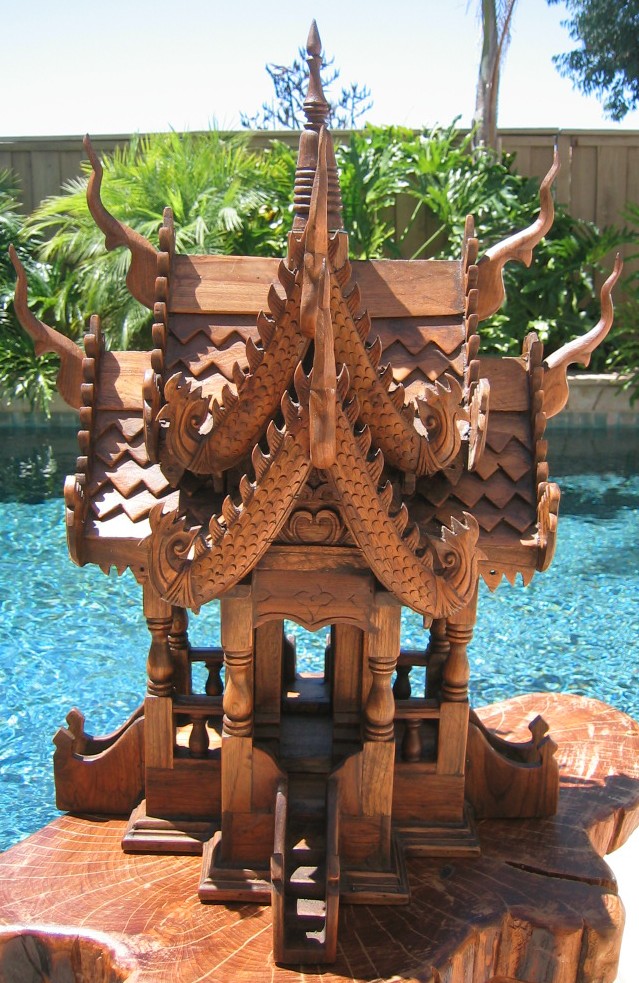
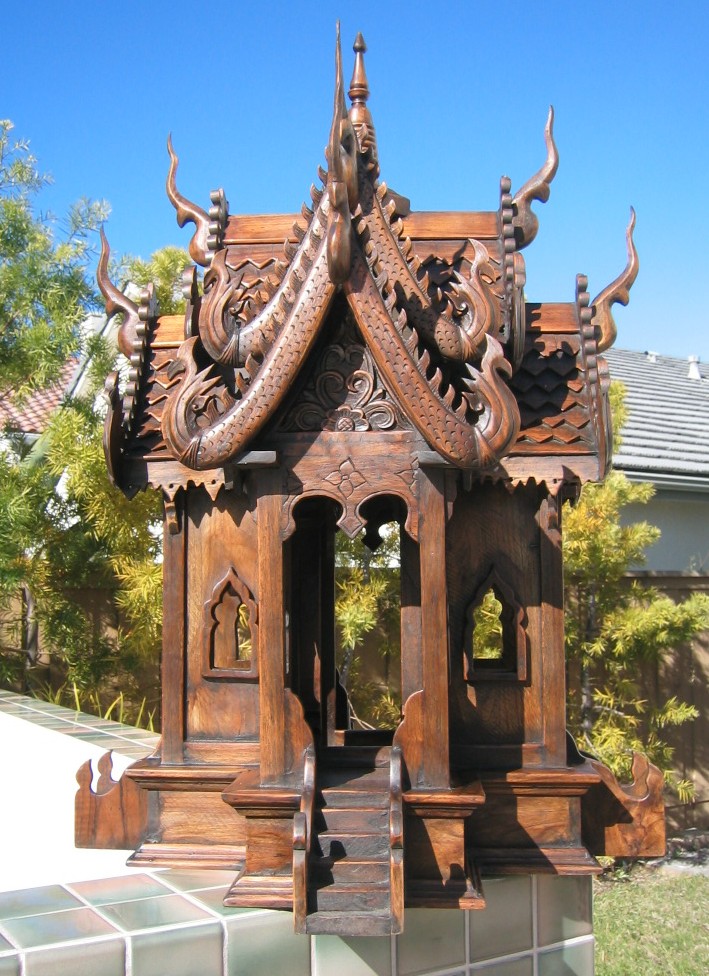
I have become fascinated with the Thai ‘spirit houses’ I see all over Thailand. Some are colorful and made of cement; others are intricately carved in teak wood. In present-day Siam, animistic rituals are still overtly practiced and given the fact that spirits are ubiquitously surrounding us, the miniature spirit dwellings are seen everywhere. They are typically set out in the outer corners of residential high-rise buildings, outside of commercial properties, in the backyards of private homes, and in shops, too. Even taxi drivers surround themselves with small replicas or altars on their dashboards. Spirits are invited to reside in these minute homes in order to protect the property and its residents. These small models of Thai houses and Buddhist temples stand on pedestals on the grounds of most properties. They are present in single and multi-family homes in cities and throughout the countryside as well. Usually mounted on bamboo or stone bases, they rest in one corner of the lot. Spirit houses show up in new and old properties to encourage fortuity and deflect misfortune. Spirit houses must be displayed predominantly in the garden and their shadow must never superimpose the main house. The Thai people believe that spirits reside everywhere, in animate as well as in inanimate objects. Spirits inhabit our world and move freely in the same spaces as humans do. They are present in trees, rocks, the oceans, and the skies. Once a home is built or a move to a new place is intended, a house for the spirits must also be brought in or constructed. We even bought one recently by the roadside that links the beach resort of Hua Hin to Bangkok. It now proudly and beautifully stands in our apartment’s foyer. When Buddhism first grasped the land of Siam over 2500 years ago, animism or spirit worship, had been experienced extensively all through the region, expanding right alongside ancient spirit beliefs. Today, animistic convictions in the spirits that reside in sacred dead trees, animals or people have been greatly fused with Buddhism. In order to appease spirits, Thais make offerings of flower garlands, incense, candles and food placing them inside and outside the spirit houses; they also sprinkle holy water obtained from monks; and place figurines inside the small dwellings to represent the residents of the bigger houses, thus bringing harmony and happiness between them. Our own American Embassy compound in Bangkok contains a beautiful and elaborate spirit house on its premises. Thai Buddhism and animism seem to be inseparable, much the same as pagan practices seem indivisible in Christianity (Christmas tree). In Thailand, Buddhism has progressed side by side with an ancient array of superstitions to explain nature, thecosmos, and the unexplainable. Religion is at the core of Thai culture; it gives life to all traditions, social systems, art and literature of the nation. Bangkok for instance, is a busy, dangerous and overpopulated metropolis; people need all kinds of protection, security and precautions to lead their lives. The phrase ‘it’s a jungle out there’ never fit a place more accurately. Perpetual and erratic traffic patterns; holes and uneven pavement on streets and almost non-existent sidewalks obstruct pedestrians from walking safely in a congestion of exhaust fumes, motorcycles, small vans, smoke spewing buses and dangerous overhead wiring connections making life a perilous daily reality. Protection is greatly needed and the spirit world is ready to provide that security. Nearly every Thai home, business company or shop includes a spirit house on their premises and daily offerings are always available. Finding comfort and security in a world of spirits is necessary; the Thais live primarily to truly enjoy (sanuk) present life but at the same time, they aim to live it with decorum, good behavior and self control as these are superior principles in the attainment of final enlightenment. Believing in reincarnation means that each individual's karma (destiny) determines their fate; an old Thai proverb says ‘Do good and receive good, do evil and that is what you will get”. By leading a superior life and observing the 5 important teachings -- helping the poor; kindness towards others; donations to monks on their early morning rounds; contributing to the temple and meditation -- attaining enlightenment becomes possible. I also just learned that merit can be transferred to others if people wish to. The belief that spirits inhabit everything that surrounds us provides contentment and comfort to the majority who by ‘making merit’ along the way -- in the manner of good deeds to others and offerings to the spirits, the monks and the Buddha -- will unquestionably afford enhanced spiritual enlightenment and immortality of the soul. Monks get the highest merit points because they have accepted life in poverty, their only possessions being their robes, food bowl, a bag, a hand paper fan and an umbrella. In all probability, believers of animism seek to make sense of natural disasters and a violent world; appeasing the spirits with material offerings provides them with a refuge and a passage to level-headedness and tranquility. By Edie Wilcox@ March 2006

Friday

Buddhist Temples of Chaing Mai

Last week I spent 8 days in Chiang Mai in northern Thailand, a city whose sheer existence has always been dependent on the gorges and valleys along the Ping River. The Ping supplied a meandering thoroughfare across the mountainous barricade that surrounds the lush valleys; a waterway that allowed the ancient city of Chiang Mai and the surrounding areas, self sufficiency while carrying out business with its powerful neighbors: China, Burma and the farther kingdoms around the Gulf of Siam. Interesting for me, was the realization that the Ping River has been the pathway alongside which commercial traffic prospered, connecting southern China with the extensive and lush areas of the Chao Phraya river basin, along whose shores thrive the metropolitan areas of Bangkok. Today, Chiang Mai is the second largest city in Thailand, an old dame still preserving her traditional charm and centuries-old culture. During the 13th Century (AD), the feudal kingdom of Lanna (the Kingdom of a Million Fields) had its center in what they called Chiang Mai (First City); their dominion spread throughout most of northern Thailand, parts of Laos and Burma (now Myanmar) and a fraction of Southern China. Theravada Buddhism arose here, following the original teachings from the Nepalese Siddharta Gautama, the founder of Buddhism, offering a resplendent legacy of cultural heritage to the areas comprised by the kingdom. Thai Buddhist temples or wats, are the heart and symbol of villages, districts, cities and towns. Temples have often served as orphanages, schools, meeting halls and hospitals, as much as places of worship. Before the creation of school buildings, the education of children was held in temples. Thai temples house an abbot who is responsible for the well-being of the community and people in difficulty always call for his advice. The abbot is often elderly with impeccable, reasonable and insightful wisdom. Monasteries are also home for unwanted dogs and cats who mysteriously find their way to the temple grounds. Every temple or wat is accompanied by brilliant color and stunning architectural design. Exquisite and very large Buddha images of gold, marble, wood or jade greet visitors from various angles making for a rather flamboyant but always thrilling experience. The Buddha images have corporeal traits that are largely determined by convention; all however, have certain generalities including very long earlobes and a lotus bud on the head which symbolizes enlightenment. Some may be sitting, reclining or standing. A temple is a large compound comprising several structures; generally, the one in the center will display Buddha images and an open area for worshippers to pray. Mural paintings relating the life of the Buddha cover the walls. On the exterior of this central structure one or many chedis, called stuppas in English, may be found, these are pointed, conical towers made of plaster, brick or stone and coated with gold, or brass. These stuppas are burial sites, generally containing the remains and relics of buried religious leaders. According to one of my guides, upon cremation, many Thais have their remains deposited into compartments on the sides of a chedi, identified by small, commemorative inscriptions attached to the outside walls. Another small structure within a temple’s grounds is the bot where the monks are ordained; this place is not accessible to women but I hear there is a sacred Buddha image within. The kuti are dwellings for monks. They can be private or shared. These rooms are small and empty as monks only meditate and sleep in their rooms. Often ordained monks have their own room while novices share. A library building almost always forms part of the temple grounds and as all other structures is usually highly decorated with small, deeply colored glass mosaics. These reflecting glass tiles are believed to drive away evil spirits because on seeing their reflection they will be driven away. As a rule, a pair of nagas or long serpent-like dragons guards stairs and doorways to deflect evil spirits from temple buildings. Monks, monk novices and orphaned children learn in the library and meditate outdoors, under the shade of a thick bodhi tree, which is said to have been the tree under which the Buddha became “enlightened”. All temples have planted Bodhi trees in their grounds. Books about Buddha teachings and doctrines are kept in the library, but there’s a wealth of other information as well; monks are more often than not, people with the greatest knowledge at any gathering. Other structures include the monks’ common living facilities where teaching and meditation as well as housekeeping and administration of the temple are left to the monks who run them. The temples of northern Thailand differ from others in the rest of the country because there is a profusion of mythical figures and creatures owing their origins to the folklore of nearby Burma and China. There are Singhas or protective lion statues; Himalayan Kinnari or beautiful female topped angels with winged bodies and large bird legs; and swan-like figures decorating gates or standing on poles in the front areas of central temple buildings. Large, heavy Buddhist bells complete the grounds as they hang from massive wooden stands on the tiled courtyard. Bells were originally used to announce scheduled events during the course of the day; nowadays, they remain for general early wake-up calls or occasions when monks (using a wooden striker) call for special activities. Smaller bells hang suspended from the horizontal beams of temple halls, gently swaying in the breeze. In front of the main Buddha image in every temple, there will be a variety of offerings such as lotus blossoms; bronze or copper money trees; incense and candles burning at different speeds, and also food. All these are contributions donated by worshippers to make merit for the future of their souls. Thai Buddhist temples are an assault to the eyes; ornate, every now and then grandiose, but always stirring, forever lingering in the mind as an example of Thailand: a passionate - but not fanatical - religious country. By Edie WilcoxJanuary 2006, Thailand

Saturday

Bridge over the River Kwai

For 20th century history buffs and the like, the bridge over the River Kwai still stands in a corner of Kanchanaburi province, a place not far from Bangkok and a historic site to visit while on an extended stay in Thailand. Notorious because of the novel by Pierre Boulle and later the film “The Bridge over the River Kwai” starring Alec Guinness and William Holden, among others, the ‘Death Railway’ as it’s been baptized, is a reality that still haunts many of the aging multi nationals that returned to the site of the Bridge to participate in a Remembrance Day in February 1976, thirty years after the end of WWII. Walking across the bridge in a symbolic gesture of reconciliation with their captors was a difficult accomplishment even three decades after the fighting. Japanese soldiers formerly assigned to the ‘death bridge’ camp came to wipe away old hostilities, but for some POW's it brought multifaceted feelings. Construction on the wooden bridge, the ‘Railway of Death’, began in early 1942. Built and assembled by prisoners of war, it was destroyed by American bomber planes before the conflict ended in 1945. The bridge was masterminded by the Japanese as part of the 415 kilometers (roughly 260 miles) of rail road track between Bangkok and Rangoon. The notorious prisoner-of-war camp ran by the occupying Japanese Imperial Army used the forced labor of 30,000 prisoners of war and more than 100,000 slave laborers from all over South East Asia to construct a railway that would link Thailand to Burma. For the length of almost two years, they were starved as they worked continually to put together the infamous Thai - Burma railroad project. Initially, Japanese army engineers had projected the railroad would take at least three years to build, however, prison campsite officials at Kanchanaburi, forced laboring prisoners to complete it in eighteen months. For POW work forces, it was a treacherous and wearing undertaking as tracks that followed the length of cliffs had to be built for long distances, and a ledge carved out of the rock in order to shape a foundation and embankment for the construction. By the end of 1943, when the ‘Railway of Death’ was completed, the Japanese were able to move daily ammunition and supplies to its military camps in Burma without the dangers of transporting provisions by sea. The bridge was subject to frequent air raids between January and June 1945 and POW labor was used to repair it on each occasion.

Because of the terrible living and working conditions, limited water and food supply, along with brutal treatment received from their Japanese captors, more than 100,000 people died building the Thai - Burma railway line. Most of the victims were from South East Asia, captured by the Japanese and forced into hard labor. Another 15,000 casualties were Allied POWs; mostly British, Australians, Dutch and a handful of Americans. I read recently, that the ‘Railway of Death’ left in its track, as many deaths as number of wooden sleepers supporting the tracks themselves. At the end of the war the British Army dismantled two and a half miles of track at the Thai-Burma border; the remaining Thai length of the railroad, some 186 miles was handed over to the State Railway of Thailand. Since then, the railroad has been upgraded and is operational and passenger trains of The State Railways of Thailand still run over part of the Burma-Siam -- as it is called now -- 'Death Railway' from Bangkok and over the River Kwai Bridge to the line's current terminus at Nam Tok. In 1946 a ‘War Graves Commission’ survey party whose task was to locate POW cemeteries and grave sites along the Burma-Thailand railway took the opportunity to recover equipment and documents which had been secretly buried, by the Japanese in the graves of deceased POWs. Temporary wooden crosses on the graves of Allied soldiers were scattered over two make-shift cemeteries, one with 1,500 graves and one with 168 graves. Some of the allied countries involved exhumed and reburied their nationals’ bodies in the Kanchanaburi War Cemetery towards the end of 1945.

The Kanchanabury War Cemetery, in sight of the Bridge, holds thousands of POWs who died while building it. The plot is sectioned according to nationality, and provides a quiet, green grassed and treed moving tribute to those who lost their lives defending their lands. Directly across the street is a museum that details the years of suffering in the 1940’s. The museum presents a replica of the bamboo huts used to house the prisoners of war. There is an on-going black and white film with actual footage taken by the Japanese, and the whole place is imbued with the whistling sounds of the popular “Bridge over the River Kwai” tune, popularized in the film. Photographs, paintings and news clips with interviews immediately following the end of the war and loads of memorabilia line the museum walls. At one end of the bridge, on the southern bank of the River Kwai, there’s a memorial plaque commemorating the historic occurrence. The inscription on the plaque placed in 1973 reads: “Thai-Burma Railway Line”. In about 500 words, it chronicles the tragic events that unfolded between the years 1942 and 1945. Edie Wilcox 12/05

Wednesday

Thai Wai

I would like to explain the Thai custom called “Wai Prah” and the graceful way of saying hello and farewell in Thailand. Just as in every other culture, Thais greet one another when they meet formally or informally. Generally, in the Western world and in business spheres of most countries, people who meet acknowledge the fact with a handshake. With the exclusion of Russians, who kiss and hug even when they don’t know one another; Eskimos, who rub noses; and Middle Easterners, who touch their heart with their right hand bowing their head slightly upon meeting you. In Thailand however, greeting is a bit more complex; people here just “wai”. This traditional “wai” symbolizes respect for another human being by acknowledging the importance of a person; the greeting is both formal and polite with the precise degree of respect conveyed in the expression. A “wai” is the motion of placing both palms together in a prayer-like gesture somewhere between the chest and forehead with a slight bow of the head and highlighted by a smile. Practiced throughout Thailand, the “wai” is a graceful sign of recognition and reverence. People’s age as well as social rank make a difference on who should “wai” first; no wonder most people in my high rise building “wai” me first thing every morning. Awareness of a person’s status is important for the exact height placement of the palms. Equals would greet by placing their hands at chest level; however, while “wai-ing” Buddha images, palms would be brought all the way to the forehead while bowing the head low in reverence. “Wais” are not offered to waiters, taxi drivers, or service and repair people; when they “wai’ me though, I do acknowledge them with a nod of the head or a smile. When I am unsure, I “wai” anyway because this shows that I do care and take the time to greet somebody, especially if the other person is older than I am. The motion of the “wai” means hello and goodbye, welcome, and thank you all in one gentle gesture. Children “wai” at grownups but this isn’t reciprocal. The elderly, though, should be “wai-ed” to; as well as high ranking officials, royalty, teachers, professors, and on greeting a doctor at his/her office. Showing reverence, obedience and respect, children within the family “wai” their parents by bringing their cupped hands all the way to the top of their foreheads; parents do not return the “wai”. Learning and discipline are important and respected by all Thais; and schools and teachers have a place of honor because they make available the tools to succeed in life. Teachers and employers are also “wai-ed” to by their students and employees respectively, and Thais of all ages and ranks respectfully “wai” to all monks. As with parents, the “wai” will not be mutual. You can imagine our confusion when within 5 days of our arrival in Thailand, a welcome reception with 200 invited Thai guests produced different degrees of “wai-ing”, and bowing. When greeting so many people “wai-ing” can be exhausting! In Thailand, the “wai” is looked on with affection, especially when coming from foreigners who have taken the trouble to learn a few simple cultural differences. Like a smile, the “wai” sends the right messages and goes a long way creating a feeling of friendliness and attention. Who would have thought a simple hello or goodbye could turn into such a cultural and consequential performance! Edie Wilcox @12/05

Loy Krathong Festival

By Edie Wilcox@ Written November 2005 This month I want to share and talk about one of the loveliest and most popular festivals in Thailand; Loy Krathong. Dates for this celebration fluctuate yearly, but they always coincide with the November full moon. During the festival, people make their way to nearby klongs (canals) or rivers in the early evening hours to set their krathongs afloat. What is a krathong? This was our first Loy Krathong in Thailand so we also wanted to know all about the krathongs and the reasons for the masses of people along the river. “Loy” means ‘to float’ and “krathong” means ‘leaf cup’. Loy Krathong is a Thankgiving festival to honor the Water Goddess for providing a profusion of precious water for a bountiful harvest. Loy Krathong is a time when a pale yellow, full moon is low in the sky and all the rivers and klongs are brimming over at the end of the rainy season. Children and adults alike float their krathongs in rivers, canals, even swimming pools, believing this will bring good luck with the next harvest season. In the rural areas, children flock to the rivers near their homes, some getting there on motorbikes, water buffalo carts, or on foot; most make wishes for a better future, good crops and clean, drinking water. In the city, wishes will vary but most will be in agreement with good health and prosperity. Krathongs are small bowls made of either interwoven banana leaves or paper mache; some are made of bread dough, varnished with resin. Most children will make their own krathong projects in school much the same way we make our own Valentines in February. krathongs may also be purchased in stores; there are all kinds of different ones all over town. Once the krathong is made, flowers, a candle and three incense sticks are placed in it. All three are lighted -- as well as the candle -- before the krathong is placed on the water. People generally make a wish once the little vessel is released. Some believe that if the candle remains burning until the krathong is out of sight, their wishes will come true. By the end of the evening, there are hundreds of flickering lights bobbing up and down rivers and canals all over Thailand. Firework displays as well as puppet shows and beauty contests are also part of the celebrations. Most hotels along the Chao Phraya River in Bangkok have special (and expensive) events to celebrate the occasion with food, beautifully designed krathongs, beauty pageants and cruises down the river to witness the glowing displays. Loy Krathong is a 700 year-old event derived from the old Kingdom of Sukhothai, the first monarchy of what is now the Thai Peninsula. The first celebration hallmarked the monsoon season’s conclusion and the most important rice harvest of the year. Historians observe that the festival parallels the farming Hindu tradition of thanksgiving; a blessing of sorts, for the abundance of rainwater received. In fact, Sukhothai farmers created the practice of floating candles down rivers and canals to carry their gratitude and best wishes to the water spirits; there’s also the tale of a beautiful kingdom woman who made the first special lanterns for the festival, she made them from banana leaves and shaped them like lotus flowers. The king was impressed with what he saw, thus he announced that krathongs would be floated down all waterways every year from then on. Today, the memory of that woman who made the first krathong is remembered in the beauty contests that take place all over Thailand on Loy krathong Day. Some people place money in their krathongs, take a bow, and set them afloat along the crowded waterways, chock full of wishes and dreams. Once krathongs are out of sight families play with fireworks and eat Tom Yum, a delicious and spicy soup made with shrimp, lemon grass and rice. On the whole, the festival celebrates a joyous family day. Following are some accounts of Loy Krathong from some of the elementary school children I visited. In their own words: Manee: “On Loy Krathong I saw a full moon in the sky. I went to the river at the town hall. I went with my father, mother and sister. I took a krathong I made at school. I lighted the candle and incense sticks in my krathong. I pushed it away onto the water and prayed. After I finished floating it, I played lucky dip. I won three marbles, some sweets and toilet paper. I played with fire works and firecrackers.” Tanet: “On Loy Krathong Day I went to the river by motorcycle. I went with my sister. I floated my krathong in the river. I saw many salespeople selling krathongs, fireworks and fire crackers. I lighted the candle and incense sticks. Afterwards, I played hide and seek. I bought three tickets for 30 baht. I won toilet paper and sweets.” Orawan: “Yesterday I went to the river near my house with my family. We took our krathongs to float. After praying, I floated my krathong. Afterwards, I bought some fireworks and fire crackers. I then played with my sister and brother. At the river I met my friends. I chatted with them for a while. Then I went to a restaurant with my family. We ate some rice and chicken fried in fresh chili paste with lemon grass and basil.” Bapoo : “I went to Loy Krathong with my mother and my sister to the river. There was a full moon in the sky and the water was high. Many people were there. We floated our krathongs from a boat in the river. First we lighted the candle and incense sticks. Then we took a vow for good luck. Then we pushed our krathongs away. After we finished we ate in a restaurant. We ate rice noodle soup with vegetables and meat. It was very delicious. Then we played lucky dip at the Red Cross stall three times. We won a glass, a pen and a plate. Then we went home.”